Living Electronics Initiative to drive bio-hybrid tech
New cross-disciplinary effort unites bioelectronics, synthetic biology and translational engineering to accelerate discovery and impact

By Matt Golosinski
What if electronics could sense, adapt and even heal like living systems? Northwestern University has launched the Living Electronics Initiative to help make that future possible.
The effort brings together researchers across engineering, materials science, synthetic biology and medicine to develop integrated systems comprising engineered biology and bioelectronics (living electronics) that can respond to the world in new ways. With potential applications in responsive therapies, environmental sensing, advanced manufacturing and biohybrid robotics, living electronics represents a rapidly emerging field with broad implications for human health, sustainability and next-generation technologies.
Led by Jonathan Rivnay, professor of biomedical engineering and materials science at the McCormick School of Engineering and Applied Science, the initiative aims to connect research areas that are already gaining momentum across the University more closely.
“Living electronics is a powerful example of what becomes possible when researchers work across traditional boundaries,” said Rivnay, who is the Jerome B. Cohen Professor in Engineering. “Northwestern already has exceptional strength in the core fields that enable this work. Now, this initiative gives us a way to connect those strengths more intentionally, build new collaborations and accelerate ideas that can make a meaningful difference in medicine, industry and the environment.”
Rivnay said the idea for the initiative grew out of ongoing “ living pharmacy” projects that combine the biological specificity of engineered cells with electrical and electrochemical sensors and actuators. These efforts aim to create responsive, adaptive platforms — devices that can sense conditions in real time and respond with targeted therapeutic action — for biologic manufacturing and delivery, including implantable or bandage-like systems designed to accelerate wound healing and treat chronic diseases such as cancer, diabetes and obesity.
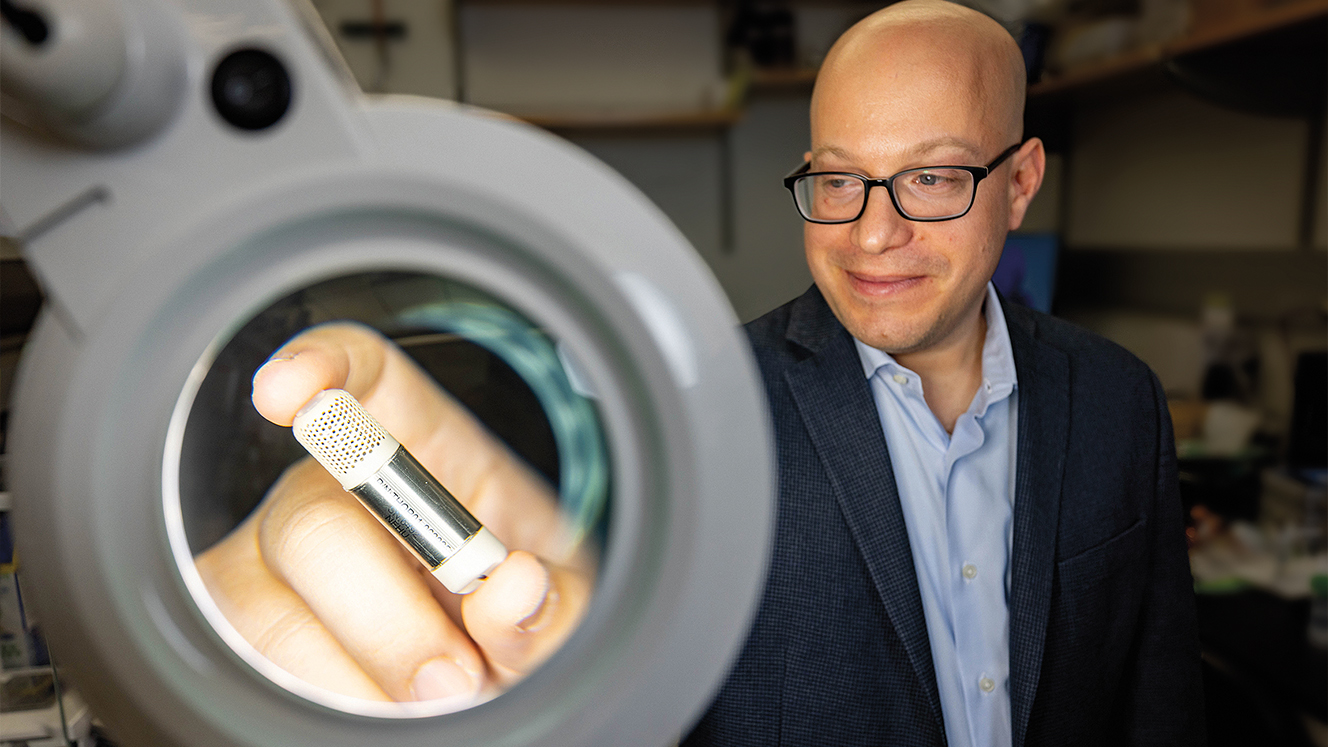
device, being developed to treat ovarian cancer.
Photo: Shane Collins
Supported by the Defense Advanced Research Projects Agency (DARPA) and Advanced Research Projects Agency for Health (ARPA-H) DARPA and ARPA-H, the work has highlighted the promise of living electronics and the need for a more coordinated structure at Northwestern to advance it.
Rivnay’s research reflects the convergence of research areas that the initiative is designed to accelerate. His group has developed soft, organic electronic materials that interface with biological systems, enabling devices that communicate with cells, tissues and physiological environments. More recently, his work has pointed toward systems that integrate engineered biology with electronic function.
Bridging biology and electronics
Electronics has long played a central role in medicine, powering therapies such as pacemakers, deep-brain stimulators and drug-delivery pumps, as well as diagnostics like continuous glucose monitors and environmental sensors. Advances in computation, wireless power and miniaturization have further accelerated progress in bioelectronics.
Biology, however, offers capabilities that engineered systems still struggle to match. Living cells and tissues can sense and produce biomolecules with extraordinary precision, adapt to changing conditions and operate with built-in error correction and efficiency.
The Living Electronics Initiative aims to bring these strengths together. By integrating engineered biology — including synthetic biology and regenerative engineering — with advanced electronics, researchers are developing hybrid systems that can sense, decide and respond in real time. Potential applications include implantable living pharmacies, responsive environmental sensors, instrumented organoids, biohybrid neural interfaces and adaptive platforms for medicine, environmental monitoring and robotics.
Connecting strengths across Northwestern’s research ecosystem
The initiative advances a core priority within McCormick’s strategic vision: expanding Northwestern’s leadership in biohybrid systems. By anchoring the effort within three established University Research Institutes and Centers — the Center for Synthetic Biology, the Querrey Simpson Institute for Bioelectronics and the Querrey Simpson Institute for Regenerative Engineering — Northwestern can scale quickly by building on existing infrastructure, expertise and collaborative networks.
Together, these centers form the interdisciplinary ecosystem that makes living electronics possible at Northwestern, combining strengths in synthetic biology, bioelectronics, regenerative engineering, materials science and translation.
“When mapping out a strategic vision for the future, the McCormick community saw great potential in the impact that biohybrid systems could have on many critical areas,” said Christopher Schuh, dean of the McCormick School of Engineering. “This initiative adds further resources to a broad array of faculty with interest in this area. I am grateful to Jonathan for his leadership in this pioneering field.”
Rather than starting from scratch, the Living Electronics Initiative connects and amplifies this foundation, accelerating discovery, enabling new proposals, expanding training and funding opportunities and creating a shared research identity for a growing community of faculty, students and collaborators.
That momentum is already visible across Northwestern. Research teams are advancing projects in living therapeutic systems (funded by ARPA-H, Breakthrough T1D), biohybrid robotics (ARO), cell-free biomembrane-based sensors and neuromorphic platforms (AFOSR) and instrumented organoids (CZ Biohub). The Living Electronics Initiative brings greater coherence, visibility and strategic lift to this growing portfolio, expanding work into new directions and application areas while drawing in additional Northwestern researchers.
As the biohybrid field gains traction nationally, Northwestern is helping shape its direction by developing soft, biointegrated sensors to detect environmental toxins, implantable and wearable devices that can monitor and treat disease in real time, and new manufacturing approaches that integrate engineered biological systems with electronic control. Researchers are also advancing biohybrid robotics and materials inspired by biological systems to enable more responsive, adaptive technologies.
“Northwestern’s greatest research strengths often emerge at the intersections of fields,” said Eric Perreault (biomedical engineering), who served as vice president for research during the development of the initiative. “This initiative is designed to build on that culture by connecting leading interdisciplinary hubs, attracting talent and creating the conditions for discoveries that would be difficult to achieve within any single discipline.”
The initiative’s leadership reflects its interdisciplinary foundation. In addition to Rivnay, the executive committee includes Northwestern researchers Josh Leonard (chemical and biological engineering and the Center for Synthetic Biology), John Rogers (materials science and engineering, biomedical engineering, neurological surgery and the Querrey Simpson Institute for Bioelectronics) and Guillermo Ameer (biomedical engineering, surgery and the Querrey Simpson Institute for Regenerative Engineering). Each is a leading figure in their field, with work spanning synthetic biology, bioelectronics, materials science and translational medicine.
The initiative also draws on a broader network of faculty advancing complementary fields. Among them are Neha Kamat (biomedical engineering, CSB), who collaborates with Rivnay and Leonard on cell-free synthetic biology systems, and Cecile Chazot (materials science and engineering), who is building a program in living materials. Together, this group reflects the range of expertise needed to support research that crosses traditional boundaries and moves seamlessly from discovery to real-world impact.
In the near term, the Living Electronics Initiative will focus on building the connective tissue needed to turn Northwestern’s strengths into an even more coordinated research ecosystem. Through seminars, conferences, collaborative programming and external engagement, the initiative will help researchers identify shared questions, form new teams and pursue funding opportunities more efficiently. Over time, it is expected to support proposal development, seed funding, training and strategic growth in areas that directly advance McCormick’s vision for biohybrid systems.